

Hook-Type Alfin Ring Carrier -- The Piston Design That Won't Let Go

What Is an Alfin Ring Carrier?
An Alfin ring carrier (also called a ring groove insert) is a high-nickel cast iron wear-resistant seat cast into the top ring groove of an aluminium piston. In diesel and heavy-duty engines, combustion chamber temperatures and peak pressures are high, so an unprotected aluminium ring groove wears and deforms quickly. A high-nickel cast iron carrier delivers high hardness and excellent thermal fatigue resistance, preserving ring groove geometry and extending piston service life.
Why Conventional Alfin Carriers Fall Off
Conventional carriers use a simple arc or straight-edged profile and rely mainly on the metallurgical bond formed during casting. In real engine operation, a serious thermal expansion mismatch works against that bond:
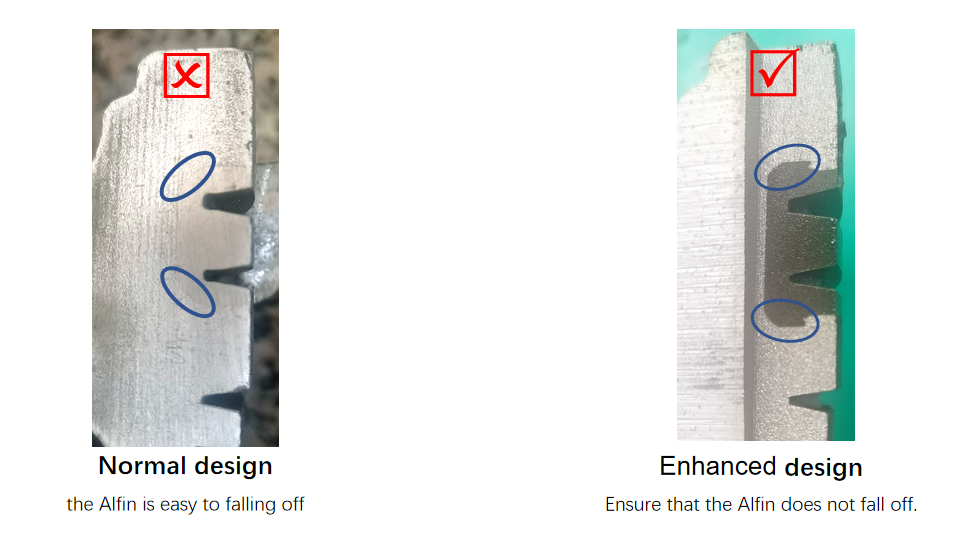
Left: conventional arc design — the carrier is easy to fall off. Right: HENWEIT hook-type enhanced design — the carrier stays locked in place.
- Thermal expansion mismatch: the aluminium piston body expands at approx. 22–24×10⁻⁶/°C, while the high-nickel cast iron carrier expands at only 10–12×10⁻⁶/°C. Aluminium grows more when hot and contracts more when cool.
- Cyclic shear stress: repeated heating and cooling generates alternating shear stress at the aluminium/carrier interface — more than a metallurgical bond alone can resist over the long term.
- Stress concentration: the contact line of an arc or straight edge becomes a stress concentration point where micro-cracks initiate and the carrier gradually peels away.
- Result: the carrier loosens, micro-moves and eventually falls off, causing ring groove distortion, poor sealing, oil consumption, blow-by and serious engine damage.
The HENWEIT Hook-Type Solution
HENWEIT machines a hook-shaped (undercut) interlocking profile into the bonding surface between the carrier and the aluminium body. After casting, the hooks form a true mechanical interlock — a dovetail keylock — with the piston body. The result is not just a tighter fit; it is a different fastening principle.
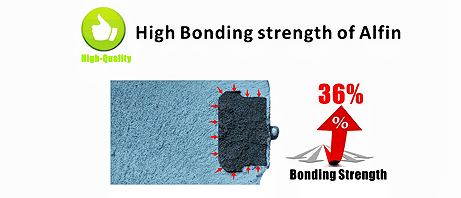
HENWEIT hook-type Alfin: bonding strength improved by approximately 36% over the conventional design.
Mechanical Retention — Like an anchor bolt, the hook profile locks the carrier axially into the aluminium body, preventing it from sliding out along the ring groove even under differential thermal expansion.
Larger Bonding Area — The hook geometry significantly increases the true aluminium-to-carrier contact area and distributes thermal and mechanical loads more evenly.
No Interface Slip — The interlock carries the shear load that would otherwise depend on friction and the metallurgical bond, sharply reducing interfacial slipping.
+36% Bonding Strength — Measured data shows HENWEIT's hook design achieves approximately 36% higher aluminium-to-carrier bonding strength than a conventional arc design.
Longer Thermal Fatigue Life — Engineered for highly boosted, heavy-duty and frequent start-stop duty cycles where thermal shock is severe.
Built for OEM and Aftermarket — Available for heavy-duty diesel, turbocharged, construction machinery and marine engine applications, in custom dimensions to drawing.
Technical Comparison
|
Item |
Conventional Arc Alfin |
HENWEIT Hook-Type Alfin |
|
Design |
Arc, rounded or straight-edged profile |
Hook-type / undercut interlocking profile |
|
Retention |
Metallurgical bonding (single path) |
Metallurgical bonding (dual locking) |
|
CTE mismatch tolerance |
Poor — interfacial shear loosening after thermal cycling |
Excellent — hook profile counteracts and resists shear displacement |
|
Al-to-carrier bond strength |
Baseline |
Up to ~36% higher |
|
Interfacial stress distribution |
Concentrated at edges, prone to cracking |
Distributed along the hook teeth, lower peeling risk |
|
High-load / thermal-load suitability |
Moderate — high risk of carrier drop-off |
Excellent — resistant to thermal fatigue and mechanical shock |
|
Typical applications |
Petrol / light-duty diesel engines |
Heavy-duty diesel, turbocharged, construction machinery, marine engines |
Why It Matters in the Field
From a materials and thermodynamics standpoint, conventional Alfin carrier failure is essentially a combination of thermal expansion mismatch and interfacial shear fatigue. HENWEIT's hook-type design changes the interface geometry and introduces a mechanical interlock, upgrading the aluminium-to-carrier joint from contact to anchoring.
Under heavy-duty, high-thermal-load and high-thermal-shock engine conditions, the hook design significantly reduces the probability of carrier drop-off and extends piston service life — a measurable reliability advantage for premium aftermarket and OEM customers alike.
Call to Action
Request Drawings, Samples or a Quote — send us your piston drawing or engine model and our engineering team will confirm the Alfin carrier design and tooling requirements.
Cylinder Head Bolts vs. Head Stud Kits for CAT® 3406E & C15 Engines

